
Where the Climate Things Are: podcast & video interview
October 20, 2025 § Leave a comment

This 59 minute interview with the delightful Addie Thompson of Where the Climate Things Are was so much fun! We talk about, among other things:
Growing up between Vermont and Denver and discovering a love of winter and skiing
How fly fishing — in various locations throughout the US, including Addie’s favorite, Kennebago Lake — became a lifelong practice
Trip leading, group dynamics, and what time in the wilderness reveals about human connection
Why geological time, mass extinctions, and perspective can help with climate anxiety
The role of fiction in shifting climate paradigms and building new climate mythologies
Click here to watch the whole interview
The Inner Game with Gwen Garcelon: radio & podcast interview on sacred nature and the new mythology
August 16, 2025 § Leave a comment
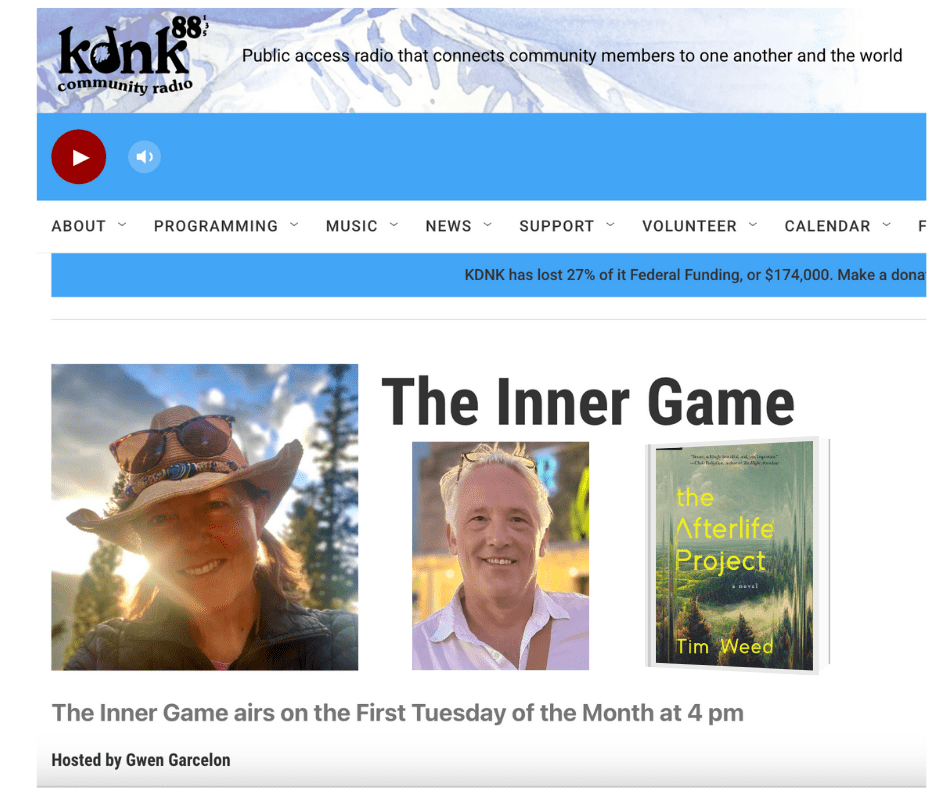
I LOVED this conversation with The Inner Game‘s Gwen Garcelon about THE AFTERLIFE PROJECT, spiritual evolution, animism, and the need for a new mythology to help us fulfill our destiny as a species to become the stewards rather than the exploiters of sacred nature. Listen to our 28 minute interview here – you won’t regret it! Also available on NPR podcasts.
“Messengers of the Eternal: Trees in Life & Literature” – new essay up at The Revelator
August 6, 2025 § 2 Comments

Such an honor to see this essay published at The Revelator, a beautiful and well-edited publication of the Center for Biological Diversity. I’ve been working on these ideas for quite some time; the essay gets at some ground truths for me about trees in fiction and also in the real world. I hope you enjoy it! Here’s a quick excerpt, and the full essay is here.
“Tolkien’s forests, similarly — where many of his most dramatic and evocative chapters take place — are gripping embodiments of this urgent wrestling match between darkness and light. The Old Forest, just beyond the borders of the bucolic Shire, is host not only to terrifying ring-wraiths but to uncanny and sometimes ravenously hostile ancient trees — and things get even worse in Mirkwood. But amid these forests of terror and danger there are also glades of joyous poetry and light, such as the alluring waystation of Rivendell and magical Lothlórien, where the cathedral-like spaces between the trees are filled with dappled golden light and the celestial music of elves.”
Burlington Free Press book round-up & a new interview at Cleaver
July 24, 2025 § Leave a comment
Just getting back from the inspiring whirlwind of The Afterlife Project book tour and almost missed a few things:

The Burlington Free Press featured The Afterlife Project in their “Summer Reading Guide of Books By Vermonters.” Needless to say, it’s an honor to be included!
Also an honor, and a conversation I very much enjoyed having, is this interview with Andrea Caswell, editor of the well-known Philadelphia-based literary magazine, Cleaver.

We discuss climate fiction, deep time, research, the novelist as archaeologist, weaving together multiple timelines, the inspirations for The Afterlife Project, and more. Check it out, I think you’ll enjoy it!
Vermont Public Radio interview with Mitch Wertlieb
June 12, 2025 § Leave a comment
What a fun and interesting conversation with Mitch Wertlieb on Vermont Public’s Vermont Edition! We talked about the inspirations and scientific research behind THE AFTERLIFE PROJECT, time travel, post-apocalyptic fiction, paleo-climatology, novel research in the great outdoors, whether stories can move the needle on the climate debate, and much more.
I drove up to VPR’s Colchester studios to record the show, and although we’ve spoken in the past this is my first time meeting Mitch in person. He’s a truly wonderful guy and a GREAT interviewer. If you’re remotely interested in any of these topics, listen to the whole interview here. (As an added bonus, the second half of the segment has beta on some great uncrowded hiking trails in Vermont!)

My thanks to Vermont Public, Mitch Wertlieb, Jon Ehrens, Andrea Laurion, Isabella Nugent, Page One Media, Podium Publishing, and the talented, lovely, and indefatigable Julia Jensen.
Big Blog Round-Up: recent interviews, reviews, and features about THE AFTERLIFE PROJECT
June 6, 2025 § Leave a comment
It has been such a pleasure as well as a humbling honor to receive a whole slew of positive attention from these amazing fellow novelists and book bloggers in the days following the official launch of The Afterlife Project. My profound gratitude goes out to you all. Highly recommended to click through, read the blogs, and subscribe.

An online interview with Mark Stevens for his blog, Don’t Need a Diagram. A highly accomplished mystery and thriller novelist himself, Mark is also one of the best literary citizens I know. His questions were acute and thought-provoking, leading to what was for me a highly substantive and enjoyable discussion about dark fiction, climate change, National Geographic, paleoclimatology, short fiction, and the solace of geological time. The interview is followed by a very perceptive book review.
Quick excerpt: “My hope for this novel is that it will offer a sense of solace, and even a kind of optimism about the future . . . to show how important it is to slow down and really try to understand what we currently have and what we stand to lose.”
An online interview with Cliff Garstang for his regular blog feature, “I’ve Got Questions.” Cliff is also a fellow novelist, author of the excellent The Last Bird of Paradise and several other books, and another very good literary citizen. Long ago we spent a very memorable week together in Tepotzlán, Mexico, taking a writing masterclass with the great American novelist Russell Banks. This brief interview touches upon the inspiration for The Afterlife Project, some of the food and music I associate with the book, and the potential of fiction to play a role in saving the human species.

Quick excerpt: “Fiction, more than any other art form, enables a reader to experience the world from within a consciousness that’s not their own. Imagining alternative lives and alternative futures—sometimes very dark ones—from the relative safety and comfort of the bedside or a favorite reading chair, putting ourselves in the position of fictional characters as they confront tense and difficult challenges, and then processing those experiences and the emotions they evoke into wisdom or at least working theories about life, is a cathartic, healthy, and uniquely human practice.”

I’m gobsmacked by this glowing review on @tamsparks’ influential book blog, Books, Bones & Buffy. Here’s an excerpt: “Tim Weed’s latest novel is a gripping and emotional time travel/post apocalyptic adventure with a fair amount of science backing everything up. It’s also full of themes like found family and even a bit of romance, but mostly it’s an ode to our planet’s natural wonder and beauty, as well as a cautionary tale about humanity’s downfall. Weed masterfully tells his story in two timelines with a great deal of distance between them—more than 10,000 years!—and it’s surprisingly effective.”
Very much enjoyed writing this guest post for Chuck Wendig’s powerhouse literary blog, Terrible Minds: “Five Things I Learned While Writing The Afterlife Project.” This post touches on the surprising power of dark fiction, one-way time travel, the nature of time, the fate of humanity, and more. My thanks to Chuck for the helping hand he regularly offers to less well-known authors. His is a blog every novelist should bookmark and read regularly, not only for the trademark madcap sense of humor, but also for its deep underlying wisdom.
Quick Excerpt: “Dark fiction isn’t for everyone, but if you like it—if you’re drawn to the writing of Stephen King, for example, or Shirley Jackson or Margaret Atwood or our own Chuck Wendig—then it’s possible that you’re the kind of reader for whom the horrific offers a particular kind of reading pleasure. Because let’s face it: there’s power in darkness. It’s an essential source of narrative drive for one thing—what keeps the pages turning—and it’s also a healthy response to personal stress and the ongoing shit-show of current events.”
My friend and Boston writing colleague Crystal King created a fascinating pairing for a book giveaway on her highly recommended substack, Tasting Life Twice. Quick excerpt: “The Afterlife Project pulled me into a chilling future that felt all too real, with a story so original and propulsive I couldn’t put it down.”
A very nice review from M.K. Tod on her blog, A Writer of History. M.K. is a Canadian historical novelist whom I first met back in 2014 when I published my first novel, also historical, Will Poole’s Island. At the time she asked me to write something about world-building in historical fiction — but it turns out those insights, as M.K. points out, are also very applicable to writing about the future!

Finally, this thoughtful review from Dr. Laura Tisdall, author, historian, and senior lecturer at Newcastle University (UK): “I was utterly immersed in The Afterlife Project, which covers some grim ground but . . . finds unexpected hope . . . And unlike so many recent eco-fictions that seek to show, as this does, that humans are merely a part of nature and not the be all and end all . . . Weed avoids nihilism, recognising the value of humanity but also its fragility. Highly, highly recommended, especially for MacInnes fans.”
“What Does a Million Years Mean to You?” New booklist essay up at Literary Hub
June 4, 2025 § Leave a comment

Very happy to have this piece up at LitHub, one of my favorite literary on-line venues.
Excerpt below:
“The deep-time perspective of all these books has given me a better vantage point on the current moment, not only as it relates to the trajectory of the human species but also to the long and varied story of life on Earth. While I do fear that humanity’s circumstances are likely to get worse before they get better, the zoomed-out perspective of deep time has given me surprising new grounds for optimism.
To paraphrase Marcia Bjornerud in Timefulness, it’s not the end of nature we’re looking at, but the end of the illusion that we’re not part of nature.”
Read the whole piece here.
 Tim Weed